Cation-controlled wetting properties of vermiculite membranes
This is a collaboration with Rahul Nair’s group at Manchester’s National Graphene Institute, and it followed a pattern that recurs in this kind of work. The experimental group had found something they could measure cleanly and could not explain: an ordinary clay mineral whose wetting behaviour swung across almost the whole accessible range depending on which cation sat between its layers, with one member of the series refusing to follow the trend that explained the rest. They came to Angelos Michaelides’ group wanting a mechanism rather than a correlation. Angelos and I did the simulations; the membrane fabrication, the contact angles, the diffraction and the separation performance are Manchester’s.
The anomaly
Vermiculite is a layered aluminosilicate that carries a permanent negative charge in its sheets, balanced by exchangeable cations in the interlayer gallery. Exchanging that cation is easy, and it changes the material’s affinity for water dramatically: the water contact angle runs from 15° for lithium to 101° for tin, superhydrophilic to hydrophobic, in what is otherwise the same material.
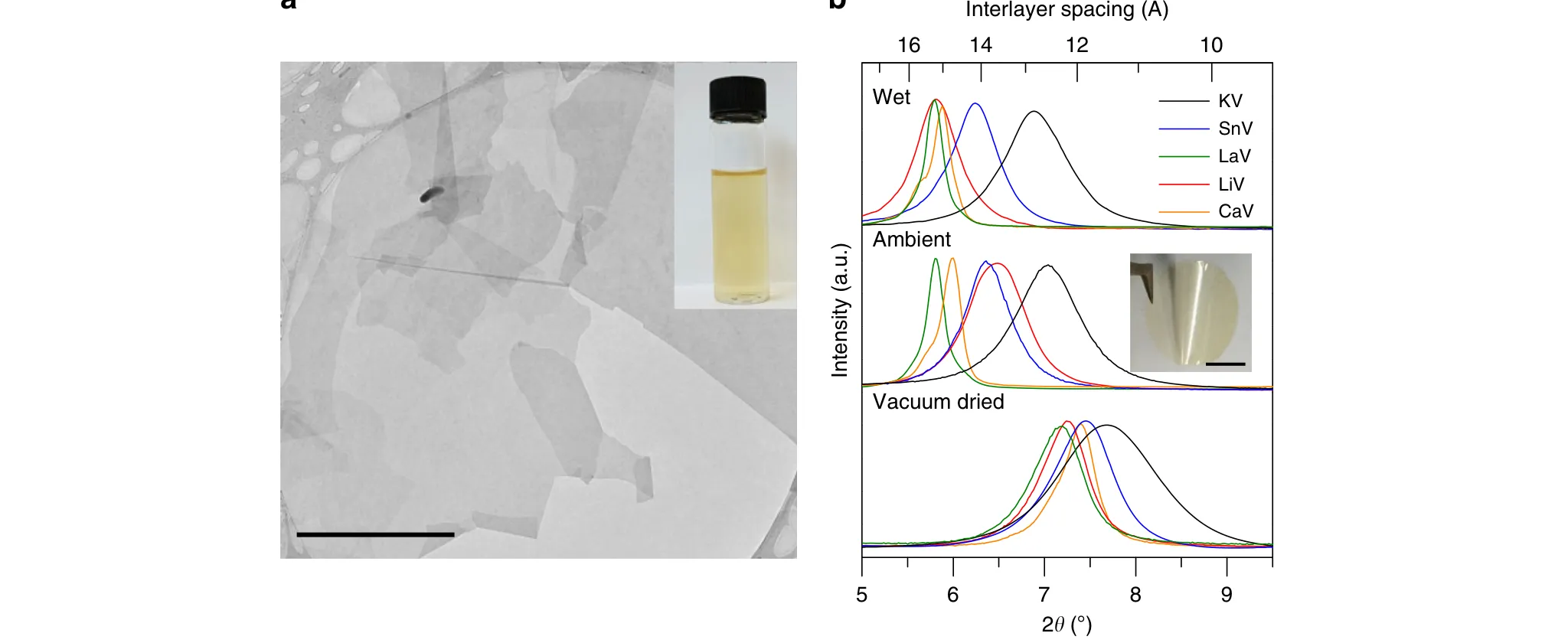
The material. Exfoliated lithium vermiculite flakes by TEM (a), and X-ray diffraction of free-standing laminates exchanged with potassium, tin, lanthanum, lithium and calcium (b), measured vacuum-dried, at ambient humidity and wet. The interlayer spacing responds to the cation and to the water content, which is what makes the series a controlled experiment rather than five different materials.
Fig. 1 from Huang, Rowe, Chi et al., Nat. Commun. 11, 1097 (2020). CC BY 4.0.
Across most of the series, hydrophilicity tracks the hydration free energy of the interlayer cation. The expected relationship, and an unremarkable one: a cation that binds water strongly in solution binds it strongly here too.
Lithium does not fit. It is markedly more hydrophilic than its hydration energy predicts, and it is the only member of the series that swells further in liquid water and then stays swollen. The diffraction makes the point: a wet lithium vermiculite laminate shows no change in interlayer spacing after a week immersed in kerosene, while a graphene oxide reference collapses from 13.5 to 8.5 Å in twelve hours.
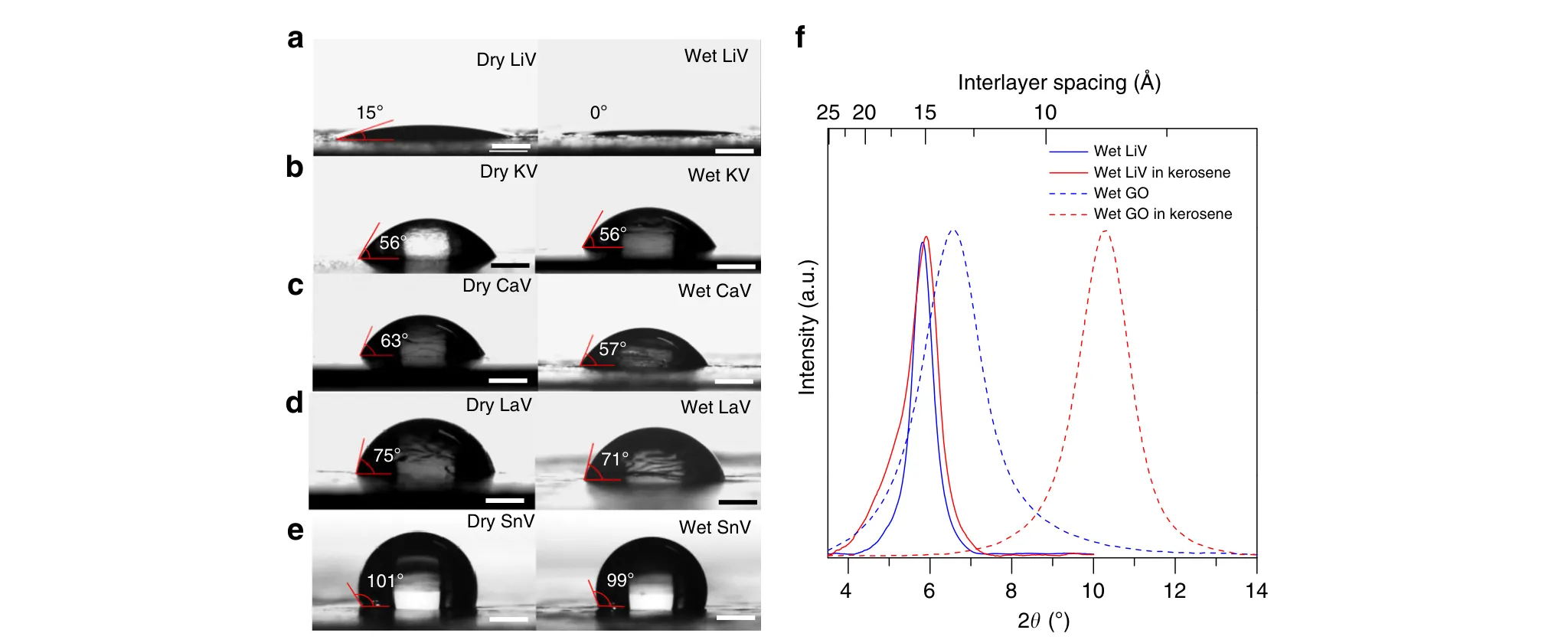
Contact angles across the cation series, dry and wet (a–e), and the diffraction showing that wet lithium vermiculite retains its interlayer water after a week in kerosene where graphene oxide does not (f). This is the experimental result the simulations were run to explain.
Fig. 2 from Huang, Rowe, Chi et al., Nat. Commun. 11, 1097 (2020). CC BY 4.0.
What the simulations showed
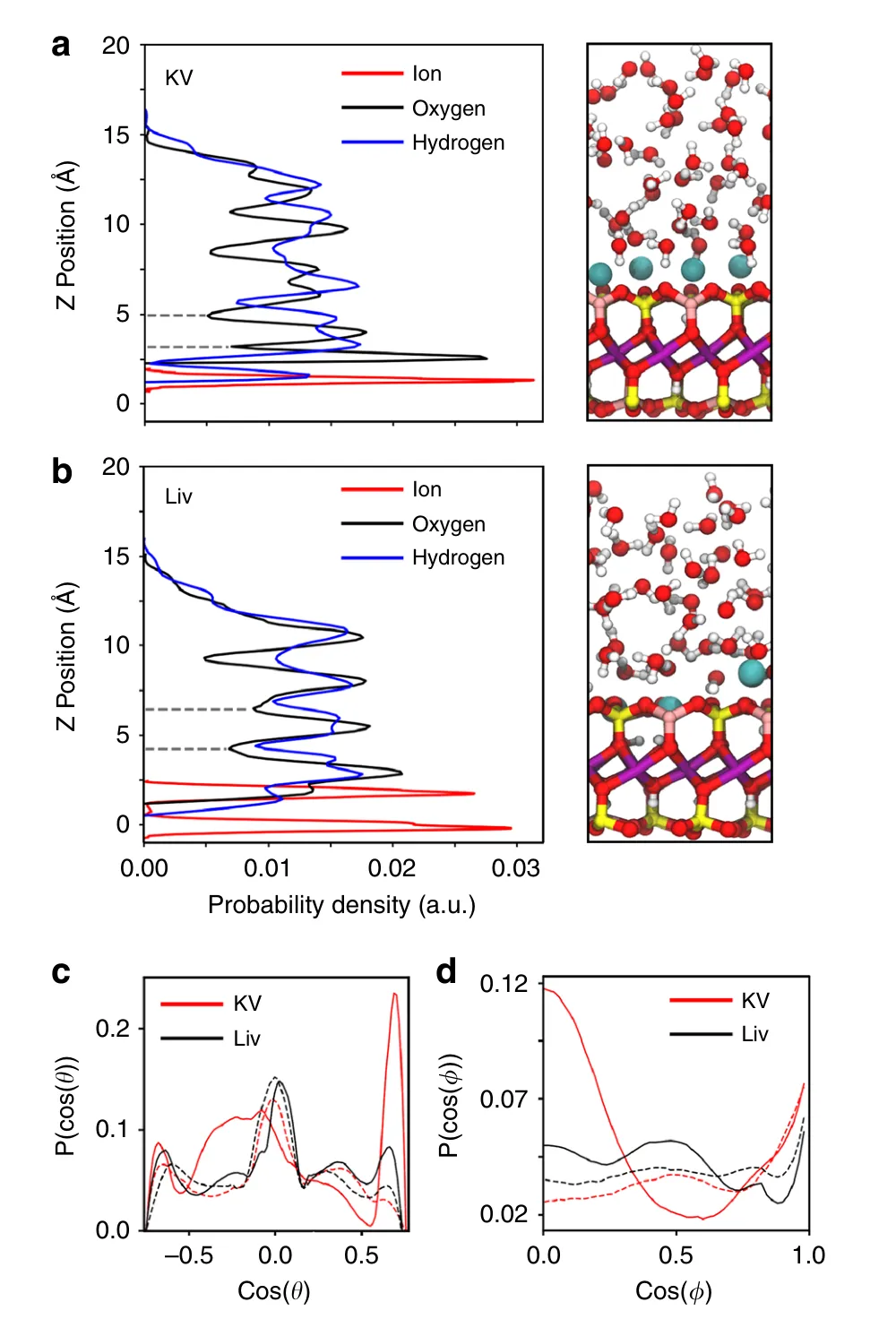
An anomaly in a bulk thermodynamic quantity usually means the microscopic picture behind the correlation has broken down, so the simulations went straight at the interfacial structure. Ab initio molecular dynamics of thin water films on the two extreme surfaces, in CP2K at PBE-D3 with a 350 Ry cutoff. The surface model substitutes 25% of the basal-plane silicon with aluminium, giving the −2e per unit cell characteristic of natural vermiculite. Films of 40 heavy-water molecules at 300 K, run for 35 ps for potassium and 40 ps for lithium.
The difference is in where the cations sit, and it is a difference of order rather than of strength.
Potassium occupies a single, strongly preferred site above the surface hydroxyls. That order propagates into the liquid: the first contact layer is sharply peaked in density and orientationally distorted, with a clear preference for one O–H bond pointing at the surface. The water is templated by the cation lattice.
Lithium populates two competing sites: chelated inside the siloxane ring, or bound to an oxygen adjacent to an aluminium substitution. Neither wins, so the cation arrangement is disordered, and a disordered arrangement offers more available adsorption sites than an ordered one. The water responds accordingly: the orientational distributions of the first and second contact layers are almost indistinguishable. Water at a lithium vermiculite interface is close to bulk-like, at the point where it is in contact with the surface.
Binding energies in the contact layer bear this out, at −0.89 ± 0.02 eV per water molecule for lithium against −0.69 ± 0.09 eV for potassium. The mechanism we proposed is that potassium’s small number of adsorption sites forces a highly ordered, high-energy interfacial layer, while lithium’s larger number of sites allows the interfacial water to relax into something much closer to bulk.
The same comparison in the second contact layer gives −0.7 ± 0.5 and −0.6 ± 0.5 eV per molecule. The error bars there exceed the difference, so the effect is not resolved beyond the first layer, and I would not claim it is.
What it was used for
Building on the lithium result, the Manchester group coated a 30 nm lithium vermiculite layer onto a polyamide microfiltration membrane. The coated membrane holds roughly 7000 L m⁻² h⁻¹ at 1 bar after a week of continuous contact with kerosene, where the bare membrane fouls badly and a graphene oxide coating survives about six hours before fouling worse than bare polyamide. Underwater oil adhesion falls below the 1 µN detection limit, against 35 µN for the uncoated membrane.
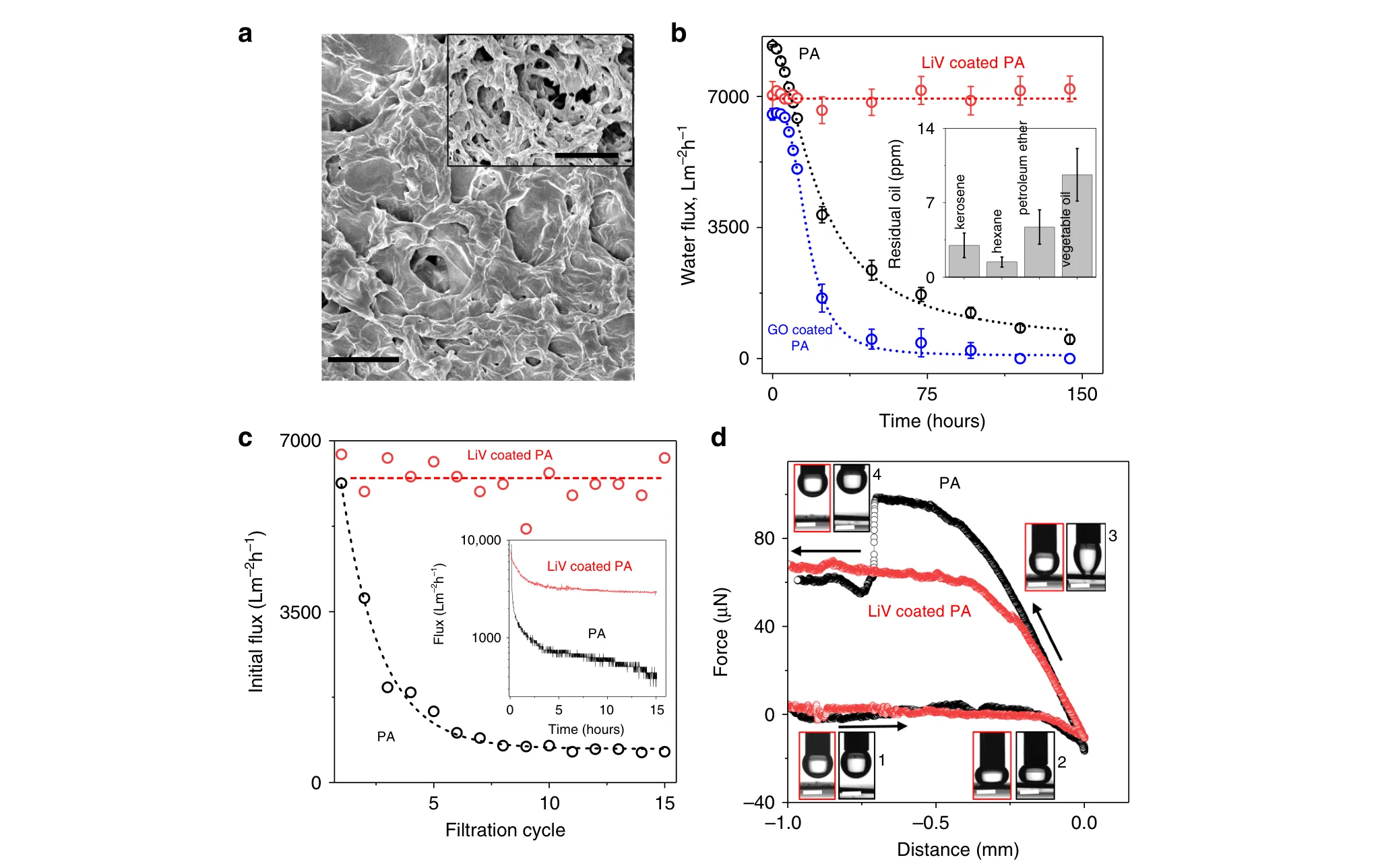
Oil–water separation with the coated membrane: the 30 nm coating by SEM (a), flux against time in contact with kerosene for coated, bare and graphene-oxide-coated polyamide (b), initial flux over fifteen emulsion filtration cycles (c), and force–distance curves for underwater oil droplet adhesion (d). The retained hydration layer is what keeps oil off the surface, so the mechanism and the application are the same result read at two scales.
Fig. 3 from Huang, Rowe, Chi et al., Nat. Commun. 11, 1097 (2020). CC BY 4.0.
Where this sits
The simulation methodology was standard practice for interfacial water in the Michaelides group: CP2K, PBE-D3, deuterated water films on a charged mineral surface with a colour-noise thermostat. It is the same broad approach as the interfacial water in the aqueous potentials paper the following year, though at direct ab initio cost rather than through a learned potential. The scale is the difference: 40 water molecules for tens of picoseconds here, against thousands of atoms for nanoseconds once a machine-learned potential is doing the work.
The comparison running through the whole paper is with graphene oxide, where cation control of interlayer spacing was already well established. Vermiculite gives an 85° swing in contact angle where graphene oxide gives about 15°, and unlike graphene oxide its hydration does not collapse in oil.
No code or input files were published with the paper.