Water flow in single-wall nanotubes: oxygen makes it slip, hydrogen makes it stick
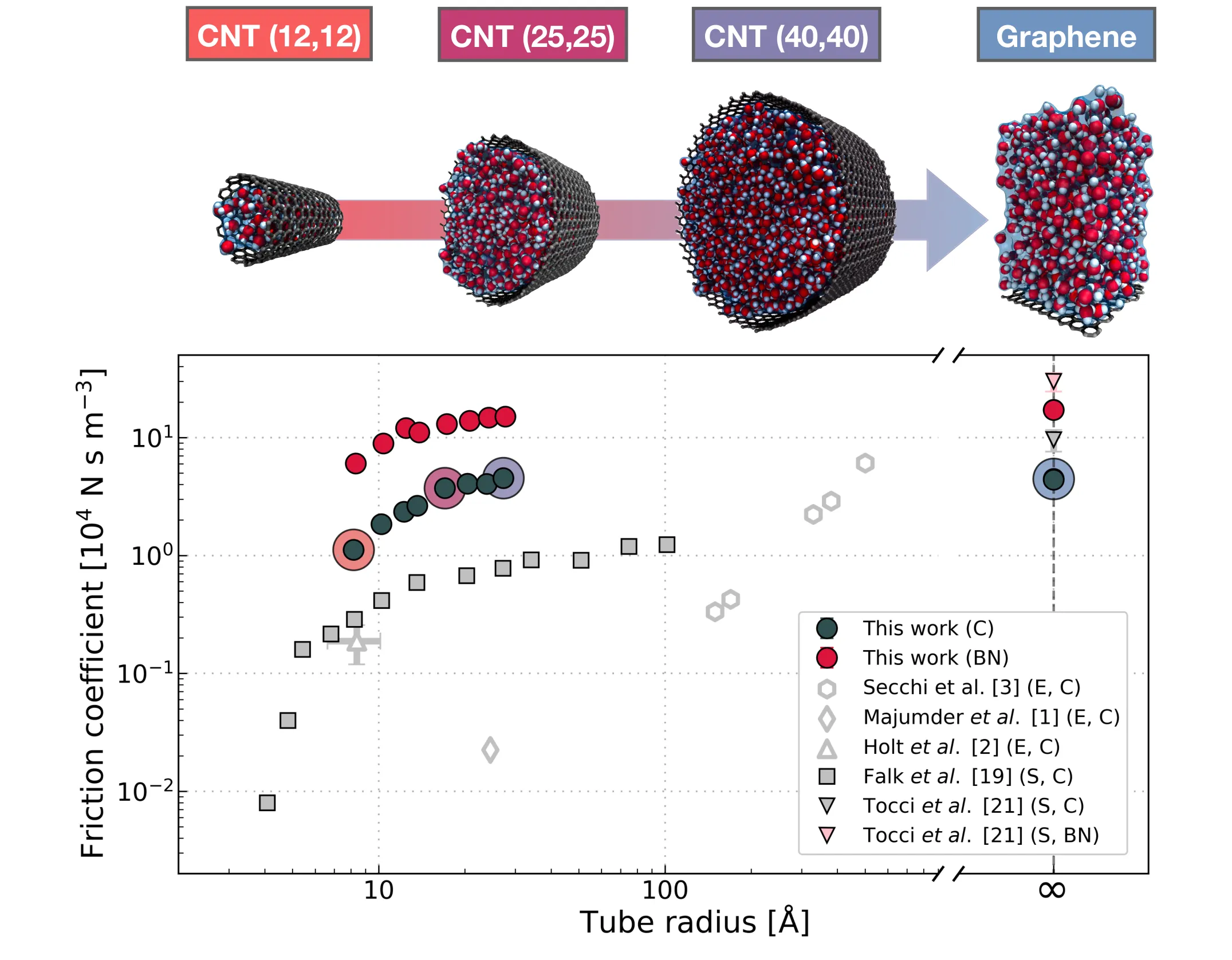
Water moves through carbon nanotubes far faster than continuum hydrodynamics allows, and the effect gets stronger as the tubes get narrower. Through boron nitride nanotubes, which are geometrically almost identical and differ only in what the wall is made of, it does not. This had been measured repeatedly since the mid-2000s and resisted explanation for well over a decade, long enough to be a standing embarrassment for a field otherwise confident it understood interfacial water.
The obstacle was not conceptual so much as computational. Explaining the difference requires electronic-structure accuracy, because it turns on how water interacts with two chemically similar surfaces; and it requires nanoseconds of dynamics across many tube radii, because friction is a fluctuation quantity and curvature is the variable of interest. Those two requirements had been mutually exclusive.
What we did
Two committee neural network potentials, one for carbon–water and one for boron nitride–water, built with the active-learning workflow from the previous year’s methods paper and trained against revPBE-D3 energies and forces. That functional was chosen deliberately: it reproduces both the structure and the dynamics of liquid water, and it matches diffusion Monte Carlo and coupled-cluster interaction energies for water on graphene and inside carbon nanotubes. A model that gets the water right and the interface wrong would answer nothing here.
The training sets were grown in three generations: the confined systems first, then bulk water and flat sheets, then configurations with quantum nuclei from path-integral dynamics. They reach 1096 structures for carbon–water and 885 for boron nitride–water. Small training sets, because the systems are narrow, which is the argument the methods paper made.
With those we simulated sixteen armchair nanotubes of each material, radii from 0.82 to 2.77 nm, plus flat graphene and hBN sheets: 966 to 8328 atoms per system, at least 1 ns each, and more than 40 ns in total. All atoms were kept flexible, walls included, so that phonon coupling between the liquid and the solid is present rather than assumed away. Friction coefficients come from a Green–Kubo relation on the equilibrium force autocorrelation, so no flow is imposed and nothing is driven out of equilibrium to extract them.
What it showed
Water experiences a friction coefficient four to five times larger on boron nitride than on the equivalent carbon system, at every curvature studied. On flat sheets the values are roughly 4.5 × 10⁴ N s m⁻³ for monolayer graphene and 17 × 10⁴ N s m⁻³ for hBN. Both materials show a strong radius dependence, narrower tubes being slipperier, and both converge to their flat-surface values above about 2.5 nm radius. The smallest boron nitride nanotube is about as slippery as flat graphene, which is a useful way to see that the two effects are comparable in size and independent.
The mechanism separates cleanly once the free energy surface of the contact layer is resolved for oxygen and hydrogen atoms separately. That separation is the paper’s real move, and everything follows from it.
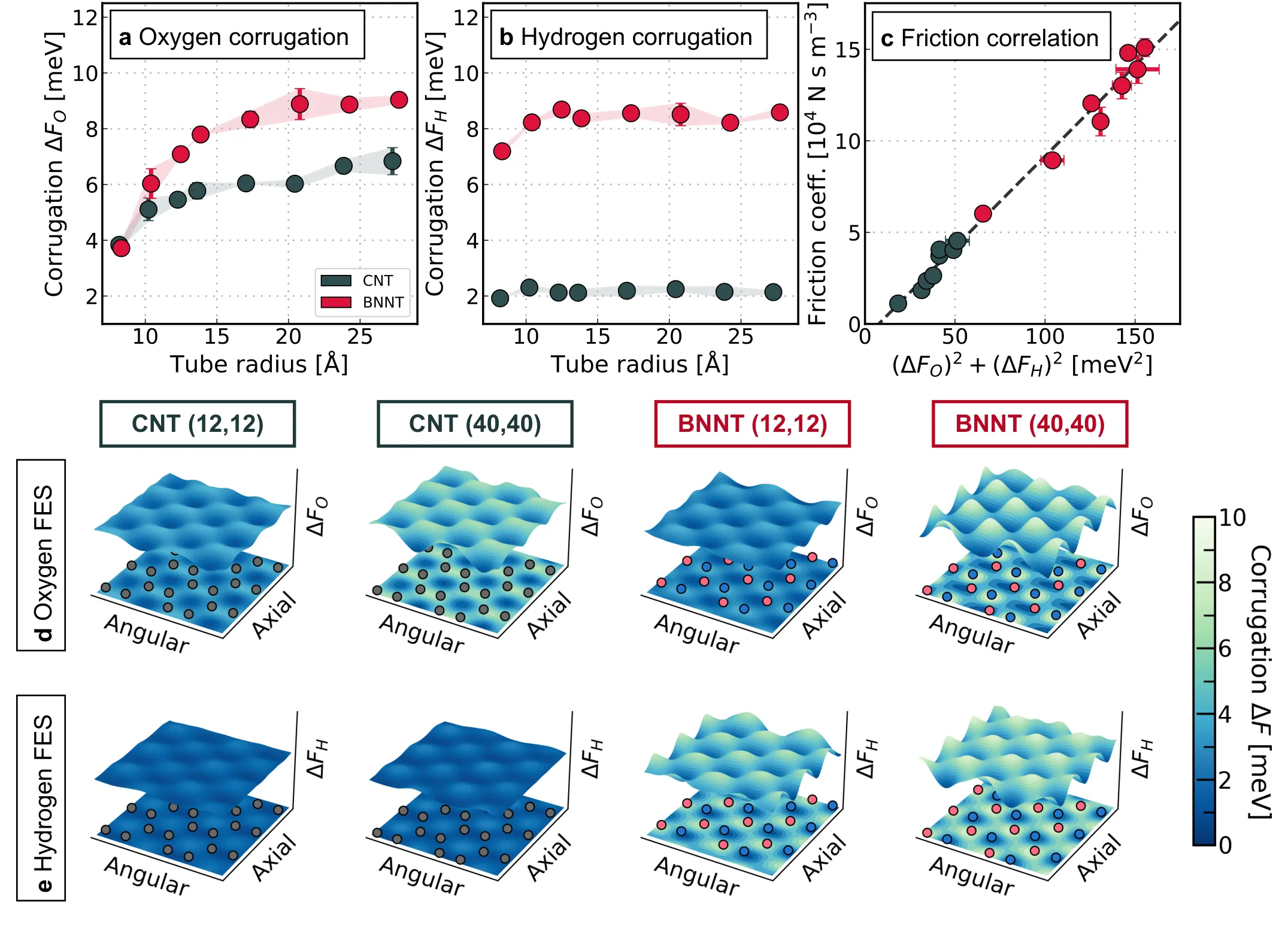
The explanation in one figure. Oxygen corrugation (a) rises with radius and is nearly identical for both materials, which is a geometric effect. Hydrogen corrugation (b) hardly depends on radius but is about four times larger on boron nitride, which is a chemical one. Panel (c) is the strongest single piece of evidence in the paper: the friction coefficient is linear in the sum of the two squared corrugations, across all sixteen tubes and both materials, which means both atom types have to be counted. Panels (d) and (e) render the surfaces themselves.
Fig. 2 from Thiemann, Schran, Rowe, Müller and Michaelides, ACS Nano 16, 10775–10782 (2022). CC BY 4.0.
The oxygen free energy surface flattens as the tube narrows, from about 3.8 meV of corrugation at the smallest radii, identical in both materials, to 6.9 meV for carbon and 9.1 meV for boron nitride at the largest. Curvature smooths the landscape an oxygen atom sees, and it does so for the same geometric reason in both materials. That accounts for the radius dependence.
The hydrogen free energy surface is essentially radius-independent, and strongly material-dependent: around 2.1 meV on carbon against 8.2–8.7 meV on boron nitride. In the narrowest boron nitride tube, the hydrogen corrugation is nearly twice the oxygen one. That accounts for the material dependence, and it is chemistry rather than geometry.
Following individual molecules makes the difference concrete. On graphene, a water molecule slides with its orientation more or less irrelevant, and the hydrogen probability density in the contact layer is close to homogeneous, within about ±2% along a cut. On hBN the hydrogens dock onto nitrogen atoms and the molecule waits there before hopping to the next nitrogen site, and the density is modulated from 0.86 to 1.18. The hydrogen–nitrogen interaction is far too weak to be called a hydrogen bond, but it raises the barrier enough to change how the liquid moves.
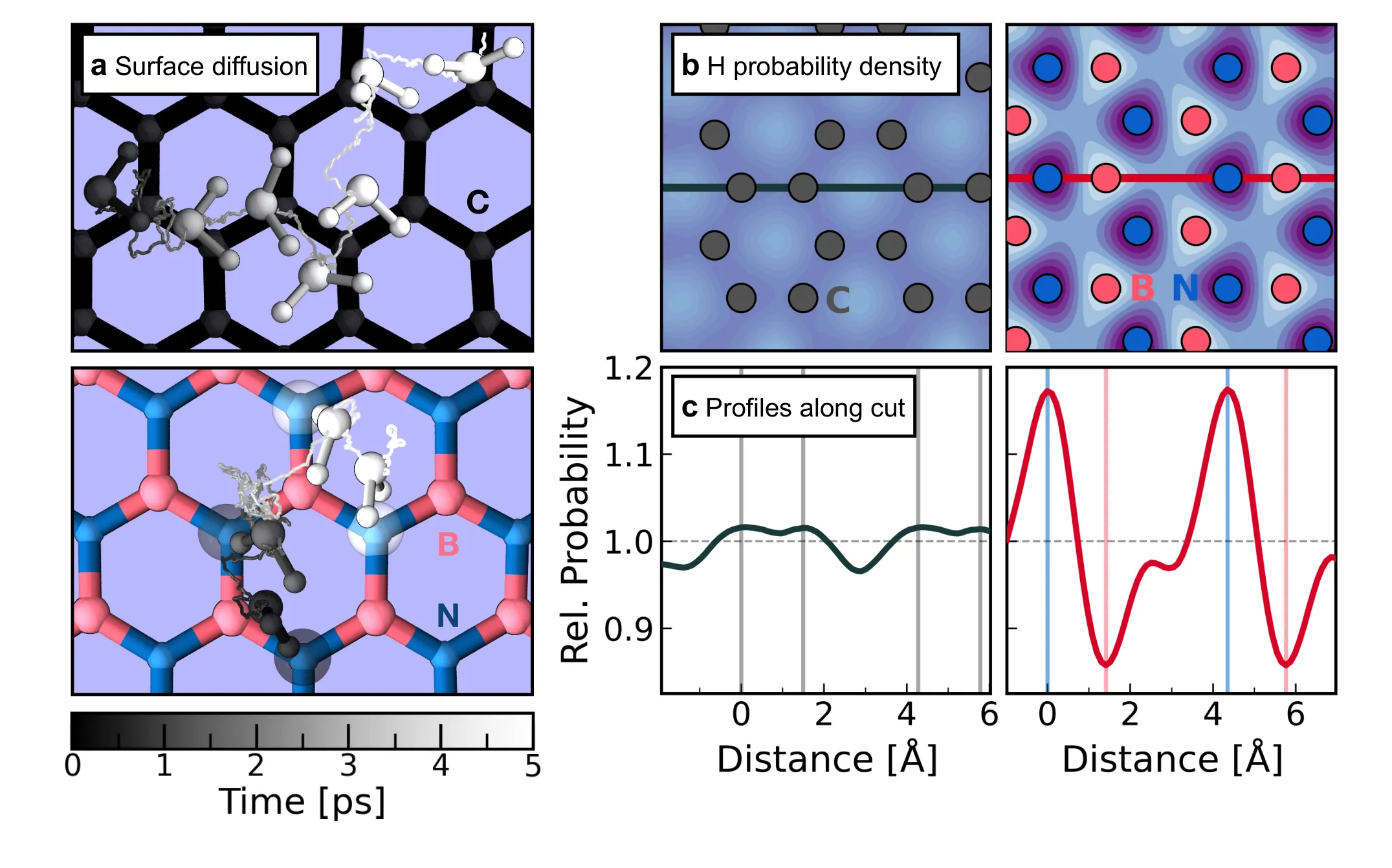
The mechanism made visible. Panel (a) traces one water molecule for 5 ps over graphene (top) and hBN (bottom), colour-coded by time, with the nitrogen atoms it docks onto marked in the matching colour. Panels (b) and (c) show the hydrogen probability density and cuts through it: near-uniform on graphene, sharply localised on nitrogen for hBN. Unconstrained sliding against docking-and-hopping.
Fig. 3 from Thiemann, Schran, Rowe, Müller and Michaelides, ACS Nano 16, 10775–10782 (2022). CC BY 4.0.
What it does not resolve
The friction predicted for carbon nanotubes is about an order of magnitude larger than nanofluidic measurements report. The paper does not explain this away. The measurements were made on multi-wall and isolated tubes, where interlayer coupling and wall rigidity differ from the single-wall systems simulated here, and there is a live proposal that electronic excitations in the wall contribute a quantum friction that no Born–Oppenheimer simulation can capture. Either could account for the gap. The honest position is that single-wall measurements are needed, and the paper says so.
For boron nitride the discrepancy runs the other way: experiments report no measurable slip at all, while these simulations find substantial slip on pristine walls. The likeliest reconciliation is surface charge from hydroxide chemisorbed on boron in alkaline water, plausibly promoted by defects. No water dissociation occurred in these simulations, so the question is left open rather than answered.
Extensive convergence tests shift the absolute numbers but leave the trends intact: water density, system size, trajectory length, hydrogen mass, choice of functional, nuclear quantum effects and wall flexibility. Both the curvature dependence and the factor of four between materials survive all of them.
Contribution
Third author of five. The work runs on the committee neural network potential machinery from the 2021 methods paper, on which Fabian Thiemann and I share equal-contribution credit.
Where this sits
This is the scientific payoff of that methods paper. Water in carbon and boron nitride nanotubes were two of the six demonstration systems there; here they stop being a demonstration and become the object of study, scaled from a single (12,12) tube to sixteen tubes up to 5.5 nm across.
It also extends earlier ab initio work from the same group. Tocci, Joly and Michaelides (2014) first found a factor of three to five difference in friction between graphene and hBN, but from short trajectories on flat sheets only, with no access to curvature. Those values are plotted alongside the new ones in the first figure. And it answers a specific suggestion by Poggioli and Limmer (2021) that the material dependence might come down to hydrogen–nitrogen interactions: separating the oxygen and hydrogen free energy surfaces is what turns that suggestion into a quantitative claim.
Neither the trained potentials nor the trajectories were deposited. The active-learning package that underlies the workflow is public.