A rational approach to selecting CD3-binding antibodies for T-cell engager development
A T-cell engager is a bispecific antibody with a job on each end. One arm grips an antigen on the tumour cell. The other grips CD3 on a T cell, and hauling the two together is what makes the T cell kill something it would otherwise ignore.
Almost all the discovery effort in the field goes into the tumour arm, because that is the part that changes between programmes. The CD3 arm gets treated as a fixed component: pick one with reasonable affinity and reuse it everywhere.
That assumption is wrong in a way that matters clinically. This work is a systematic demonstration of how wrong, and a procedure for doing it properly.
Why the CD3 arm is not interchangeable
The therapeutic problem with T-cell engagers is not usually potency. It is the gap between killing tumour cells and triggering cytokine release syndrome. The same T-cell activation drives both, and a molecule that kills well but releases too much IFNγ, IL-2 and TNFα is not a drug. The width of that window is a property of the whole molecule, not of the tumour arm alone.
Two findings from the panel make the point directly.
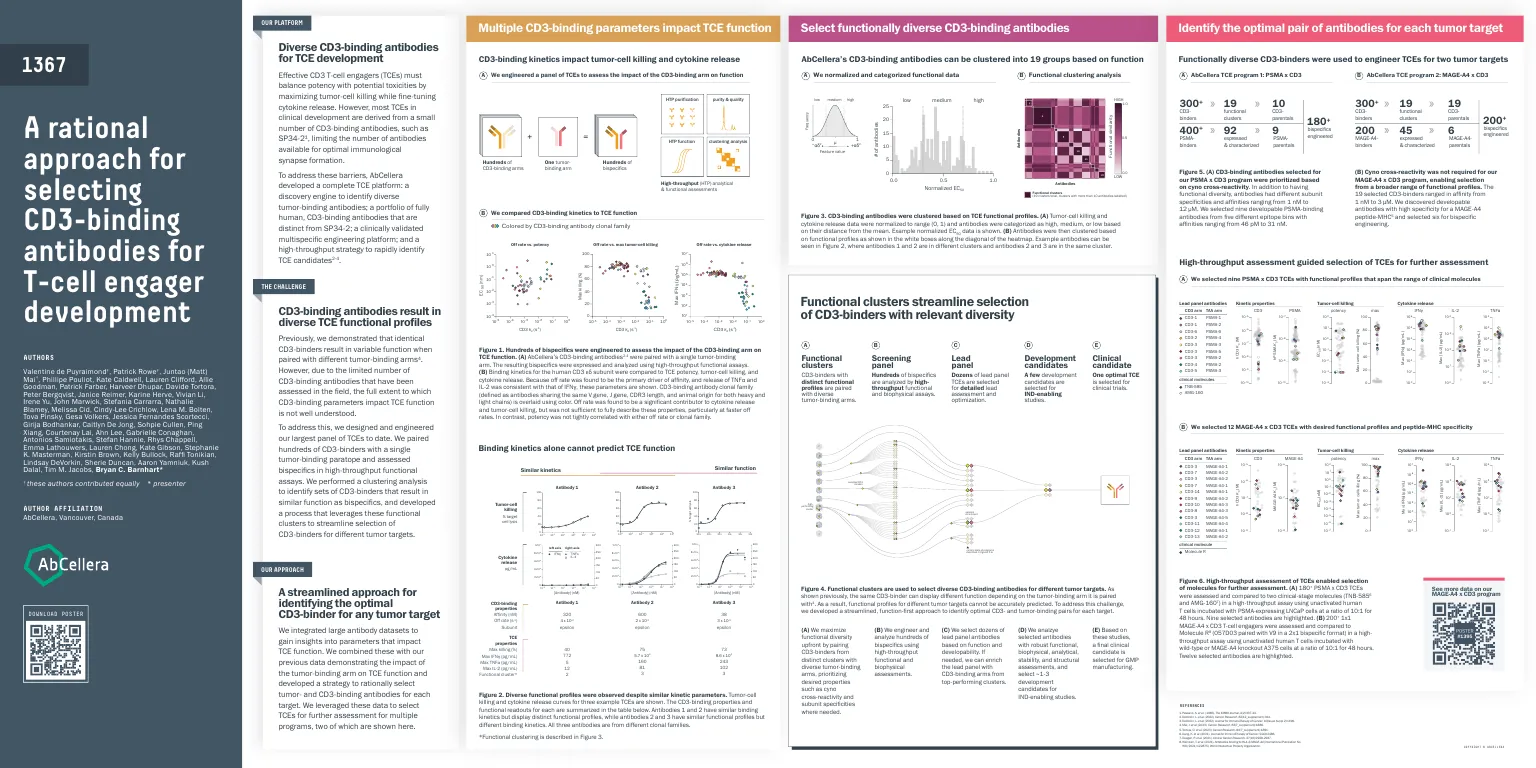
The same CD3 binder produces materially different functional profiles depending on which tumour arm it is paired with. So a binder has no context-free profile to be selected on.
And CD3 binding kinetics alone do not predict potency. Off-rate does correlate significantly with both tumour-cell killing and IFNγ release, which is the one clean biophysical handle in the dataset, but the correlation is not tight enough to select on. Molecules with closely matched kinetics land in quite different functional places.
Between them these rule out the two cheap selection strategies: reuse a favourite binder, or rank the panel by affinity.
What was done instead
Characterise the CD3 binders by what they do rather than by what they bind, and cluster on that.
Every binder in the portfolio was profiled in high-throughput T-cell-dependent cellular cytotoxicity and cytokine release assays: unactivated human T cells at a 10:1 effector-to-target ratio over 48 hours, with IFNγ, IL-2 and TNFα quantified alongside killing, and binding kinetics measured separately by surface plasmon resonance. Hierarchical clustering of those functional readouts resolves the portfolio into 19 distinct functional clusters.
The clusters are then the selection unit. Rather than choosing binders, you choose across clusters, which spans the functional space deliberately instead of sampling it by luck.
Two programmes ran the procedure end to end. For PSMA: 400 tumour-binding parentals, paired against 92 CD3 binders drawn from 9 functional clusters, giving over 180 bispecifics, from which 9 leads were taken forward. For MAGE-A4: 300 tumour parentals against 19 CD3 binders drawn from all 19 clusters, giving over 200 bispecifics and 12 leads.
In both cases the resulting panels span the clinical benchmarks rather than clustering around one profile; the PSMA leads bracket TNB-585 and AMG-160. The deliverable is not a single optimised molecule but a panel with known coverage of the efficacy–toxicity trade-off, which lets a programme make an informed choice later rather than an early bet.
Contribution
Equal contribution with Valentine de Puyraimond and Juntao (Matt) Mai; the three of us carry the dagger on the poster. Bryan C. Barnhart is senior author and presented it.
Where this sits
This is the selection machinery underneath the programme pages rather than a result about one target. It feeds directly into the peptide-MHC T-cell engager work, where the MAGE-A4 numbers above are that programme’s front end, and it sits inside the broader antibody selection and engineering workflows built at AbCellera.
It builds on the company’s earlier CD3-binder discovery and its multispecific engineering platform. A companion poster from the same period, Novel CD3-binding antibodies to drive potent tumor-cell killing and optimal cytokine release, covers the discovery end of the same question; I have not given that one its own page, since it is the same body of work presented to a different audience and two pages would say one thing twice.
This is also the clearest case on the site of the same skill applied to a different science. Measure a large panel, find the axes that actually organise it, then select along them: that is the question from the carbon potential benchmarking, with antibodies in place of interatomic potentials.
The poster
 Click to enlarge